01 / DECIDE
Know what must exist
Convert an operational need into controlled geometry, material, and acceptance criteria.

The next industrial age will be built by organizations that can turn decisions into physical output before the world changes again.
Convert an operational need into controlled geometry, material, and acceptance criteria.
Carry design intent through quote, DFM, routing, production, inspection, and shipment.
Put a real part into the hands of the people who must test, install, learn, and decide again.
Make each production cycle faster and more certain than the one before it.
It is already demanding power systems, data infrastructure, machines, vehicles, tools, enclosures, assemblies, and millions of parts that do not yet exist.
Software can model the future in seconds. Compute can evaluate thousands of possibilities. Networks can distribute a decision around the world almost instantly. But the physical world still has to be cut, formed, machined, joined, finished, inspected, packed, and delivered.
That gap is where the next era will be won or lost. Not between those who can imagine and those who cannot, but between organizations that can turn intent into hardware and those that remain trapped in coordination.
Ideas are multiplying faster than industrial systems can realize them.
The scarce resource is increasingly the ability to translate a decision into a verified object. A design may be complete while its quote waits in an inbox. A purchase order may be approved while process questions remain disconnected from the model. A machine may be available while the material, program, tooling, revision, and inspection plan exist in separate systems.
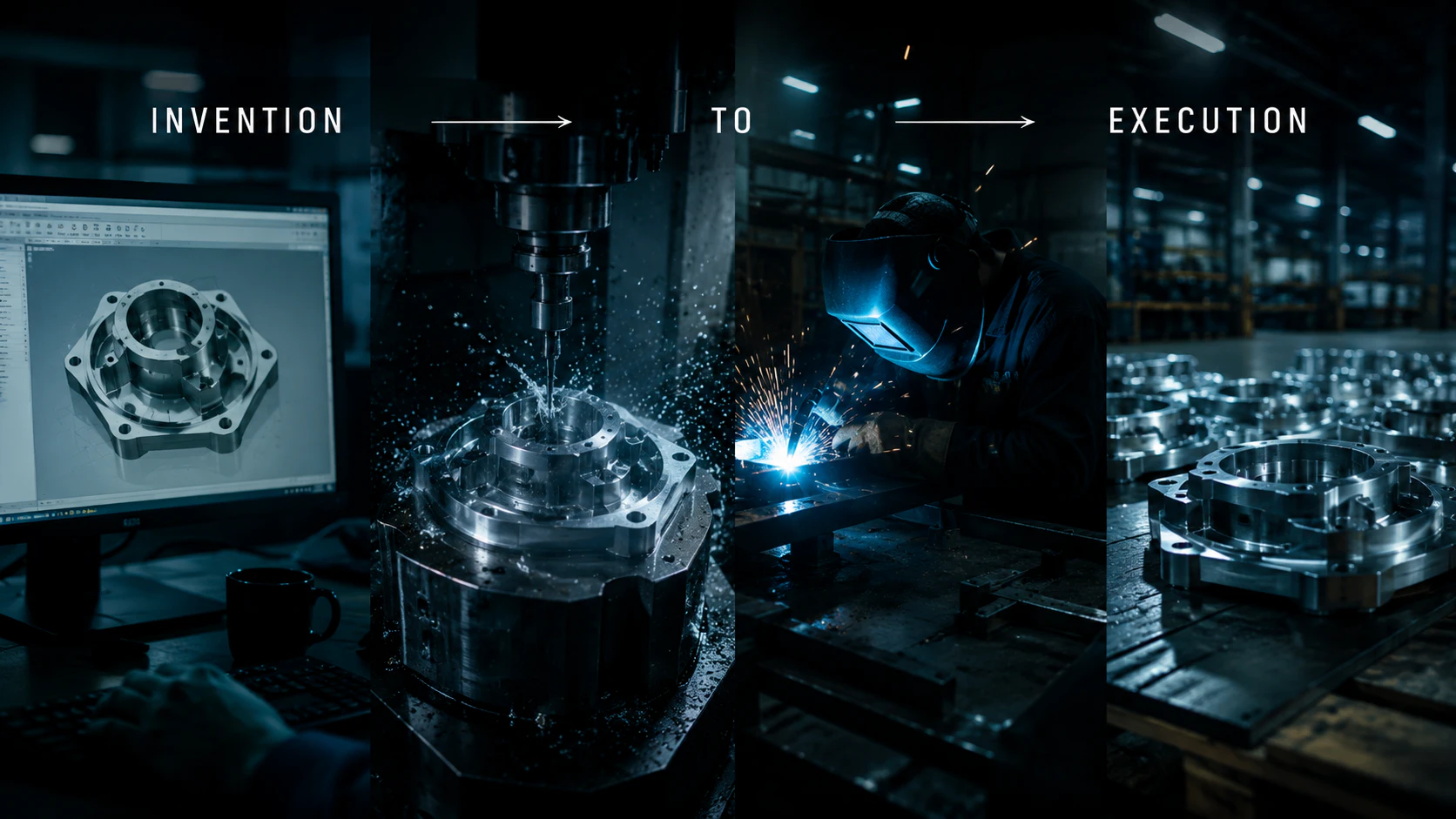
Every boundary creates latency. Every manual re-entry creates another chance for intent to fracture. The result is familiar: the design is digital, but the route to production still behaves like paper.
Manufacturing is the execution layer of any organization whose mission depends on the physical world.
Material, labor, tooling, and machine hours have always shaped cost. Now the time between those elements determines strategic relevance.
A part delivered after the decision window closes may be dimensionally correct and operationally useless. A prototype received while the design team can still act creates information. A replacement shipped before a line stops preserves output. A fixture that arrives before a launch keeps the schedule intact.
Speed is therefore not a cosmetic service level. It changes what an organization is able to attempt. When the cost of trying is lower and the result arrives sooner, teams can test more options, identify failure earlier, and commit production with better evidence.
The industrial system must behave as a connected cycle: define, validate, produce, verify, deploy, and learn.
CAD, material, tolerance, finish, quantity, and function create a usable production definition.
Quote logic and manufacturability review expose geometry, access, bend, tooling, and process constraints.
Material, machines, programs, tooling, people, and schedules converge on the controlled revision.
Inspection compares the physical result with the requirements that actually control function.
Packaging and shipping move the part to the build, test, line, installation, or customer that needs it.
Performance in the real world informs the next revision, quantity, process, and production decision.
The objective is not to automate every judgment. It is to preserve context so that people can apply judgment where it matters. A connected loop makes the state of the part visible, keeps the revision coherent, and turns each completed order into better information for the next one.
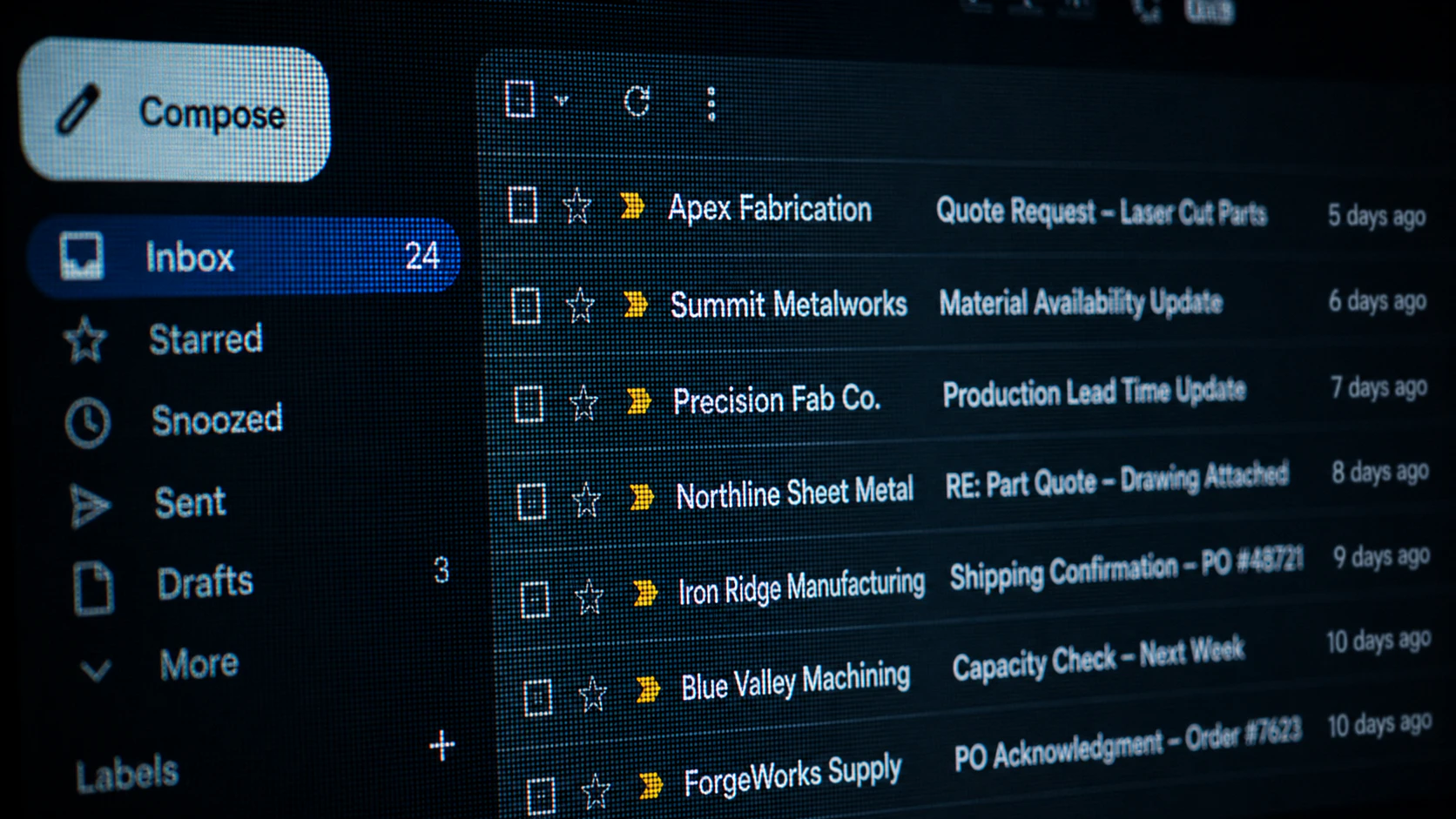
Manufacturing built around email, attachments, callbacks, and disconnected spreadsheets cannot move at the speed of modern engineering.
Email is useful for communication. It was never designed to operate a factory. It cannot understand the CAD file, validate the material, simulate the bend, reserve capacity, preserve a live production state, or move the job forward on its own. Every message creates another queue. Every reply waits for another person.
Velocity without control is not speed. It is waste arriving sooner.
The winning system compresses delay while strengthening the link between intent and evidence. It knows which revision is active. It records what material and process were selected. It surfaces manufacturability risk before production. It verifies the dimensions and requirements that matter. It keeps a human decision point wherever ambiguity carries real consequence.
The ability to build cannot remain locked behind who knows which shop, who answers first, or who has time to assemble a manual quote.
Industrial capacity becomes more useful when an engineer can access it through the same interface used to define the part. That does not make manufacturing virtual. It makes the route to real machines clearer. Software becomes the connective layer between customer intent and the people, equipment, material, and quality work required to produce the result.
This is how advanced manufacturing becomes available at every scale: to the enterprise building a new platform, the infrastructure team facing a compressed schedule, the startup iterating toward a design freeze, and the fabricator working from a garage who needs one professional part to move forward.
Xeon NC connects instant quoting with real manufacturing so the first useful action can happen when the need is understood—not days later.
Upload the CAD. Select the process, material, quantity, and finish. See the quote. Resolve manufacturability questions. Release the work. Then move from prototype to repeat production without rebuilding the commercial path from the beginning.
There are no minimums. One part can be enough to test an idea. Applications engineering can review the model and the requirements behind it. When the design is ready to scale, the same digital path can support the next quantity.
Build the part that creates evidence. Learn from it. Then build the next version faster.
Upload Parts & Get a QuoteIt is the total time from a defined need to a verified, usable part. Quoting, manufacturability review, programming, material, production, inspection, and shipping all belong to that clock.
No. Sustainable velocity comes from connecting requirements, planning, production, and verification. The goal is to remove waiting, duplicate entry, and disconnected decisions—not to remove process control.
Xeon NC creates an online path from CAD upload and instant quoting into manufacturability review, production, inspection, and shipping. This reduces the manual handoffs that make a conventional RFQ cycle slow.
Yes. Xeon NC has no minimum order. A team can order one part, validate the design, learn from the physical result, and scale when the design is ready.
Yes. Xeon NC can review part geometry, manufacturability, materials, processes, tolerances, finishes, and inspection requirements before production.
The future will not be manufactured by waiting for certainty. It will be manufactured by systems that create it.
Start an Instant Quote