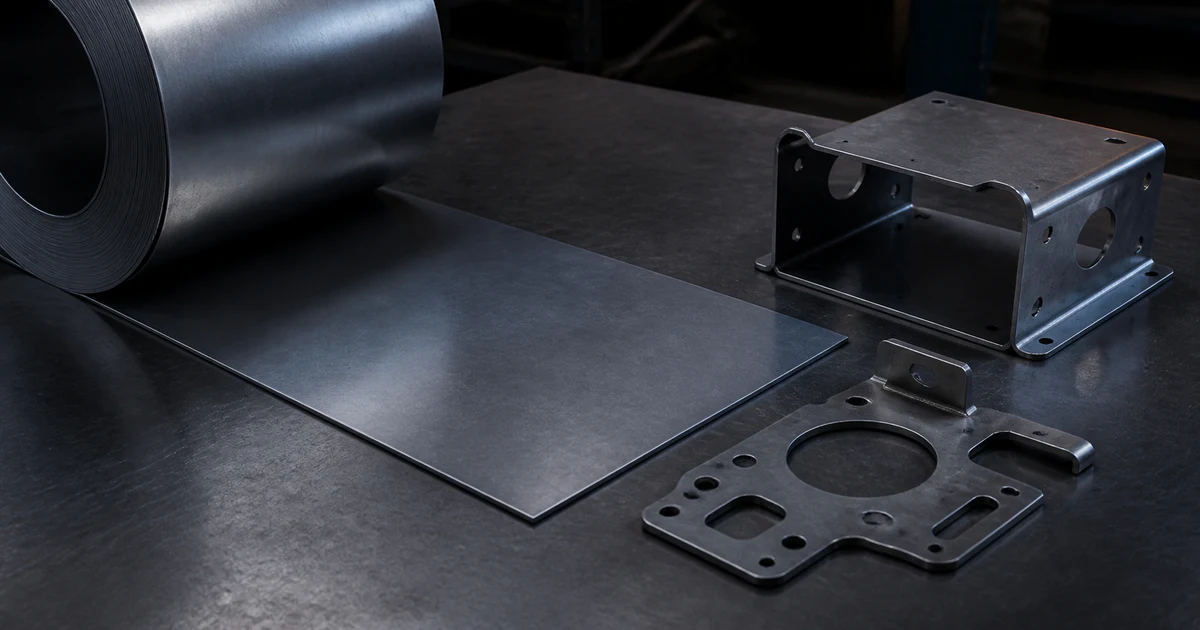
What cold rolling changes, what ASTM A1008 actually specifies, and how to choose, call out, laser cut, bend, weld, coat, and protect carbon steel sheet.
ASTM A1008 / A568Updated August 202615 minute read
Cold-rolled steel sheet starts as hot-rolled coil. It is cleaned, reduced closer to final thickness at lower temperature, annealed when required, and temper rolled to deliver the requested surface, shape, and mechanical response.
The word cold does not mean the steel is refrigerated. It means the major thickness reduction happens below the steel's recrystallization temperature. That reduction gives tighter dimensional control and a smoother, scale-free surface, but it also work-hardens the metal. Annealing restores ductility; a light final temper pass controls surface texture, flatness, and yield behavior. The exact mill route varies with designation and ordered properties.
01 / Hot roll
Make the coil
Cast slab is reduced at high temperature into hot-rolled sheet coil.
→
02 / Pickle
Remove scale
Acid cleaning removes the hot-rolling oxide scale before cold reduction.
→
03 / Cold reduce
Set thickness
Rolls reduce thickness and change surface, shape, and mechanical response.
→
04 / Anneal
Restore ductility
Heat treatment recrystallizes cold-worked sheet for the ordered formability.
→
05 / Temper roll
Control surface
A light pass sets matte texture, improves shape, and helps suppress stretcher strain.
"CRS" is incompleteCold-rolled steel may be soft drawing sheet, commercial sheet, structural sheet, HSLA, full hard, or controlled-hardness strip. A quote can use CRS as shorthand; a production drawing should identify the governing product standard and designation.
02 / ASTM A1008 Designation Map
Choose formability, strength, or hardness on purpose.
ASTM A1008/A1008M-26 covers multiple cold-rolled sheet families. The letters after the standard are the part of the callout that tells the mill what performance is being purchased.
CS
Commercial Steel / Types A, B, C
General fabrication
The usual starting family for cabinets, brackets, panels, covers, and moderate bends. Chemistry is controlled, but typical rather than mandatory mechanical behavior can apply unless the order adds requirements.
General sheetCS Type B common
DS
Drawing Steel / Types A, B
More severe forming
Selected when the part needs better drawability than commercial steel. Useful for deeper stampings, drawn shells, and geometry where strain distribution matters more than a simple brake bend.
DrawingStamping
DDS / EDDS
Deep / Extra Deep Drawing
Maximum draw latitude
Low-carbon and interstitial-free approaches support demanding cups, shells, and complex drawn forms. They are specialty choices, not automatic upgrades for an ordinary laser-cut bracket.
Deep drawComplex form
SS
Structural Steel / Graded by yield
Guaranteed strength
Structural grades provide specified mechanical properties. Higher yield supports lighter sections but increases forming load and springback and can reduce tight-radius latitude.
Yield gradeLoad carrying
HSLAS
High-Strength Low-Alloy / Classes 1, 2
Strength with alloy control
HSLA sheet uses microalloying to raise strength. Class and grade affect chemistry, strength, welding, fatigue, and forming behavior. Do not substitute generic commercial steel bend data.
High strengthClass matters
HSLAS-F
HSLA with Improved Formability
Strength plus forming
Designed to retain more formability at elevated strength. It can reduce mass in engineered parts when material sourcing, bend validation, joining, and final properties are controlled.
LightweightingImproved forming
RH / FH
Required Hardness / Full Hard
Hardness-controlled sheet
Used when hardness or as-cold-reduced condition is the purchase target. Full-hard sheet has not received the formability-restoring anneal assumed for ordinary commercial sheet.
HardnessLimited forming
SHS / BHS
Solution / Bake Hardenable
Automotive property routes
Strength is managed through solid-solution or paint-bake response. These grades belong in an engineered material system with controlled forming, coating, and final-property validation.
AutomotiveProcess dependent
A1008 is not "AISI 1008"ASTM A1008 is a sheet-product specification with several designations. SAE/AISI 1008 is a chemistry-oriented grade name. The similar numbers do not make them equivalent callouts, and neither should be silently substituted for an ordered A1008 designation.
03 / Cold Rolled vs. Other Sheet
Choose the surface and protection system together.
Cold-rolled, hot-rolled P&O, galvanized, and stainless can all become a bracket. They do not arrive with the same surface, tolerance logic, corrosion behavior, thickness range, or cost.
Attribute
Cold-rolled A1008
Hot-rolled / P&O A1011
Galvanized A653
Surface
Smooth matte, usually oiled, no mill scale
As-rolled scale or pickled scale-free surface
Zinc-coated; coating appearance and designation matter
Typical choice
Thin precision sheet, enclosures, visible powder-coated work
Heavier fabrication, frames, structural and cost-driven work
Parts needing sacrificial zinc protection before paint or exposure
Dimensions
Generally tighter sheet thickness and shape control
Broader hot-rolled tolerances and heavier availability
Base steel plus coating mass; coated-sheet tolerances apply
Corrosion
Bare steel rusts; mill oil is temporary
Bare steel rusts; P&O oil is temporary
Zinc provides sacrificial protection; cut edges and welds still need review
Coating prep
Excellent smooth substrate after cleaning and pretreatment
Scale must be absent; surface and oil need controlled prep
Use a coating system compatible with zinc and welding repairs
Where stainless fits
Stainless is a different alloy family, not a cold-rolled carbon-steel finish. It creates corrosion resistance through chromium-rich passive behavior and may be supplied in cold-rolled finishes such as 2B. Specify stainless when its corrosion, hygiene, heat, or appearance performance justifies the alloy premium; specify A1008 plus a coating when economical carbon steel and an engineered finish meet the service.
04 / U.S. Specifications
The product standard comes before the nickname.
A1008 defines the cold-rolled sheet family. A568 supplies general requirements and tolerances. Related products move to different standards even when they look similar on a rack.
Specification
Scope
Common use
Important boundary
ASTM A1008/A1008M-26
Cold-rolled carbon, structural, HSLA, hardness-controlled, solution-hardened, and bake-hardenable sheet
Commercial sheet, drawing sheet, structural and HSLA cold-rolled sheet
Does not cover cold-rolled strip defined by A109/A109M.
ASTM A568/A568M-25a
General requirements for hot- and cold-rolled carbon, structural, and HSLA sheet
Ordering, dimensions, tolerances, flatness, analysis, and general acceptance
The individual product specification prevails if requirements conflict.
ASTM A109/A109M-24
Cold-rolled carbon steel strip, 0.25% maximum specified carbon
Closer tolerances, specified temper, edge, or finish in strip sizes
Strip and sheet are differentiated by size, tolerances, temper, finish, and edge.
ASTM A1011/A1011M-25
Hot-rolled carbon, structural, HSLA, HSLAS-F, and ultra-high-strength sheet and strip
Hot-rolled mill finish and pickled-and-oiled sheet routes
Do not write A36 as a generic replacement for every hot-rolled sheet product.
ASTM A653/A653M-25a
Hot-dip zinc-coated or zinc-iron-alloy-coated sheet
Galvanized and galvannealed sheet with coating designation
Galvanized is not simply A1008 with an informal finish note.
A useful general-fabrication callout
COLD-ROLLED STEEL SHEET, ASTM A1008/A1008M-26, CS TYPE B, 0.060 IN NOMINAL, MATTE FINISH, OILED, THICKNESS TOLERANCE PER ASTM A568/A568M, MTR REQUIRED
Product
COLD-ROLLED STEEL SHEET — not generic "mild steel"
Designation
ASTM A1008/A1008M-26, CS TYPE B — change CS to DS, SS, HSLAS, or another designation when the design needs it
Thickness
0.060 IN NOMINAL; THICKNESS TOLERANCE PER THE APPLICABLE ASTM A568/A568M TABLE OR A JUSTIFIED DRAWING REQUIREMENT
Surface
MATTE FINISH, OILED; STATE EXPOSED FACE, SURFACE CLASS, OR APPEARANCE SAMPLE WHEN COSMETIC
Records
MTR / C OF C, HEAT OR COIL TRACEABILITY, DOMESTIC-SOURCE OR MELT REQUIREMENTS IF CONTRACTUALLY REQUIRED
Do not invent a strength from the words "cold rolled"Commercial and drawing steels may be selected primarily by chemistry and formability, while SS and HSLAS grades carry mandatory mechanical requirements. If yield, tensile, elongation, hardness, or bend performance is design-critical, purchase the designation that guarantees it.
05 / Gauge, Thickness & Tolerance
Gauge is a label. Decimal thickness is the requirement.
Steel gauge numbers are convenient in conversation, but they are not universal across metals and do not replace the ordered decimal thickness or ASTM tolerance.
Different gauge tables exist for standard steel, galvanized steel, stainless, and nonferrous sheet. Service centers also round nominal stock labels. A drawing that says only "16 ga" can create a mismatch in the CAD flat pattern, bend deduction, weight, hardware grip, weld fit-up, or inspection plan.
Common Xeon A1008 stock labels
22 ga0.030 in
20 ga0.036 in
18 ga0.048 in
16 ga0.060 in
14 ga0.075 in
13 ga0.090 in
12 ga0.100 in
11 ga0.120 in
10 ga0.135 in
These are Xeon inventory/quoting labels, not a substitute for the governing ASTM ordered-thickness tolerance or a supplier's certified actual thickness. Availability and sheet size can change; quote from the exact material selection shown in the platform.
Why actual thickness matters
A bend program uses measured thickness, not a gauge nickname. Material variation changes the inside radius developed in air bending, bend deduction, tonnage, springback, flange location, and hardware fit. For unusually tight assemblies, tolerance the function and coordinate it with available sheet rather than applying a blanket tight raw-stock tolerance.
06 / Surface, Oil & Shape
Smooth does not mean cosmetic or corrosion-proof.
ASTM A1008 sheet is supplied matte and oiled unless otherwise indicated. That is an excellent fabrication and coating substrate, but it is still an industrial mill surface.
Matte
Standard surface
Texture for forming and coating
Temper-rolled texture reduces a mirror-like appearance, supports lubricant control during forming, and provides a consistent base for pretreatment and paint. It is not a decorative stainless finish.
Mill oil
Temporary protection
Useful in storage, removed for finish
Oil helps limit flash rust during shipping and storage. It must be cleaned with a process compatible with the coating, welding, adhesive, or cleanliness requirement.
Surface class
Order when needed
Two faces are not automatically equal
Exposed automotive or appliance panels can need special surface-quality language, inspection, and packaging. General A1008 sheet does not promise a flawless show surface.
Flatness
System property
Coil memory and residual stress remain
Cold-rolled sheet has tighter shape control than typical hot roll, but leveling, slitting, laser heat distribution, asymmetric geometry, forming, and welding can still release stress and distort a part.
Keep it dry and identify the final faceCondensation under film, wet fingerprints, water-based cleaner residue, and long storage in uncontrolled humidity can stain or rust bare sheet. Mark the cosmetic face, package dry, and move promptly into the specified protective finish.
07 / Laser Cutting & Edge Quality
Oxygen is productive. Nitrogen changes the edge.
Cold-rolled mild steel is excellent fiber-laser material. Assist-gas choice affects speed, edge oxide, downstream coating, and welding preparation.
01 / Oxygen cut
Fast mild-steel route
Oxygen supports the cutting reaction and is widely used for carbon steel. The edge carries oxide; remove it where coating adhesion, welding, electrical contact, or customer acceptance requires bare metal.
Nitrogen can produce an oxide-free edge at the cost of higher gas demand and different speed/capacity economics. It is useful when the downstream process benefits enough to justify it.
Ordinary oiled A1008 is not the same as film-protected stainless or coated galvanized stock. Confirm surface condition and remove incompatible residue before welding or finishing.
Very small holes, narrow webs, dense perforations, acute corners, and shared lines can increase local heat and distortion. Use actual process capability rather than one universal minimum-feature multiplier.
A laser-cut perimeter may need only loose dross removal, or it may need a defined burr limit, edge break, rounded edge, cosmetic grain, coating-ready surface, or safe-handling requirement. Put the outcome on the drawing. "Deburr" alone does not define radius, direction, appearance, or measurable acceptance.
08 / Bending & Forming
The ordered designation drives the press-brake result.
Commercial and drawing-quality A1008 sheet can form very well. Structural, HSLA, full-hard, and hardness-controlled sheet need different radius, tonnage, springback, and cracking assumptions.
A1008 CS Type B and A1008 HSLAS Grade 70 are not the same bend.
02
Use measured thickness
Actual sheet, die opening, and punch radius set the developed inside radius and bend deduction.
03
Respect rolling direction
Tight critical bends are normally safer across the grain; qualify the worst orientation.
04
Allow for springback
Higher yield strength generally needs more overbend and more generous radii.
Use shop bend data tied to the actual material family, thickness, tooling, and press. A universal K-factor or "inside radius equals thickness" rule can be a starting assumption for CAD, not a guarantee. Validate flange minimums, hole-to-bend distance, reliefs, tonnage, bend sequence, grain direction, and final angle on representative stock.
Full hard is not ordinary CRSFull-hard or required-hardness sheet can crack where annealed commercial sheet bends easily. Do not accept a harder substitution because the packing slip still says "cold rolled."
09 / Welding, Hardware & Assembly
Clean the surface and design for heat movement.
Low-carbon cold-rolled sheet is commonly MIG, TIG, spot, seam, and laser welded. Thin geometry makes burn-through, distortion, fit-up, coating access, and final datum control more important than raw weldability.
01 / Surface prep
Remove incompatible oil and coating
Clean the joint area using the approved process. Identify any plating, primer, adhesive, or unknown shop residue before applying heat; coatings can change weld quality and fume hazards.
KNOW: BASE METAL · OIL · COATING · CLEANER · FUME · FIRE RISK
02 / Distortion
Thin sheet moves
Use fit-up control, balanced joint design, short welds where structurally appropriate, sequencing, tacks, fixturing, and realistic final tolerances. Dimension critical features from final-state datums.
PLAN: GAP · TACKS · SEQUENCE · FIXTURE · SHRINKAGE · FINAL INSPECTION
03 / Resistance welding
Fast sheet-to-sheet joining
Spot and projection welding can be efficient for cabinets and assemblies. Stack thickness, electrode access, surface condition, coatings, nugget size, spacing, shunting, and appearance require a qualified schedule.
PEM-style nuts, studs, standoffs, rivet nuts, and clinch hardware depend on exact sheet thickness, hardness, hole size, edge distance, installation side, and coating sequence.
SPECIFY: PART NUMBER · HOLE · THICKNESS · HARDNESS · FACE · INSTALL / COAT ORDER
Weld filler and procedure must match the base designation, strength requirement, joint, coating, and code. HSLA and high-strength sheet may require different filler, heat-input control, bend/weld location rules, and property validation than CS Type B. Do not let "mild steel" erase the certified grade.
10 / Corrosion Protection, Drawing & Safety
Bare cold roll is unfinished steel.
The smooth mill surface makes an excellent substrate, but iron still rusts. Cleaning, pretreatment, coating selection, drainage, edge coverage, and assembly details determine service life.
Protection routeChoose for the real environment
01
Indoor decorative enclosure?
Clean and pretreat, then powder coat or paint with complete edge, hole, and recess coverage.
02
Outdoor or wet service?
Engineer the full system: pretreatment, primer, topcoat, seam and fastener design, drainage, UV, salt, condensation, and maintenance.
03
Zinc protection required?
Consider specified galvanized, galvannealed, electrogalvanized, or post-fabrication plating rather than treating zinc as an informal finish substitution.
04
Electrical ground or weld point?
Mask or restore defined contact areas and protect surrounding edges; document bare-metal locations so they do not become accidental corrosion sites.
Drawing and RFQ checklist
01
ASTM standard, designation, type, grade, and class
Example: ASTM A1008/A1008M-26, CS Type B. Add strength grade/class when structural or HSLA.
02
Exact decimal thickness and governing tolerance
Gauge may remain as a parenthetical shop reference, not the sole acceptance requirement.
03
Surface, oil, cosmetic face, and packaging
State matte/oiled condition, exposed face, scratch or dent acceptance, dry packaging, and storage needs.
04
Rolling direction and bend requirements
Show direction when radius, cracking, springback, fatigue, or repeatability depends on it.
05
Edge and hole acceptance
Define assist gas if required, oxide removal, burr, edge break, dross, countersink, tapped holes, and insert preparation.
06
Welding and inserted-hardware controls
Reference WPS, filler, weld size/length, distortion datums, hardware part number, installation face, and proof tests.
07
Pretreatment, coating, masking, and final thickness
State coating standard, color/gloss/texture, film thickness, corrosion test if meaningful, masking, threads, and final inspection state.
08
Certification, traceability, and source requirements
Specify MTR/C of C, heat or coil traceability, marking, domestic preference, approved source, and record retention.
Safety starts with knowing the surface
Laser cutting, welding, grinding, and coating preparation create fire, eye, skin, noise, gas, and fume hazards. Mill oil, rust preventive, paint, zinc, adhesive, cleaner, and unknown coatings can change the exposure. OSHA identifies metal fumes and ultraviolet radiation as welding/cutting health hazards and requires suitable controls under the applicable standards. Use the current SDS, hazard communication, ventilation and extraction, PPE, hot-work control, compressed-gas practice, and facility safety program.
Never hot-work an unidentified coatingConfirm the base material and every surface treatment before cutting or welding. Galvanized, painted, plated, solvent-wet, or contaminated sheet may require different preparation, ventilation, respiratory protection, and fire controls than bare oiled A1008.
11 / FAQ & Sources
Fast answers before material is ordered.
It is steel sheet reduced closer to final thickness at lower temperature after hot rolling and scale removal, then annealed and temper rolled as required. The route improves surface and dimensional control. It does not define one chemistry or strength.
No. ASTM A1008 is a cold-rolled sheet-product specification with many designations. SAE/AISI 1008 is a chemistry-based grade name. Write the product standard and designation needed by the design.
CS Type B is a common starting point for general laser-cut and bent sheet. Select DS or deeper-drawing grades for severe stamping, and SS or HSLAS when certified strength is required.
Normally yes for service. Mill oil is temporary shipping and storage protection. Clean and pretreat the fabricated part, then apply a coating or metallic protection system designed for its moisture, salt, chemical, UV, wear, and maintenance exposure.
It is better when you need thin sheet, a smoother scale-free surface, tighter dimensional control, and an excellent coating substrate. Hot-rolled or P&O sheet can be more economical and more available at heavier thicknesses. The application decides.
Use 0.060 inch nominal with the governing tolerance. You may add 16 gauge as a shop reference. Gauge systems differ by metal and stock label, while bending and inspection use actual thickness.
This guide is educational. It does not replace the current purchased standard, mill certification, structural design, qualified bend data, WPS, coating specification, inspection plan, or written safety program for the actual part.
From coil designation to coated assembly
Ready to review your steel part?
Send the model, drawing, material callout, finish, quantity, and end-use requirements. We can evaluate the geometry and identify the manufacturing questions that should be resolved before material is ordered.