Light learns to copy itself.
The laser did not begin as a machine. It began as a strange implication buried inside the new physics of the atom.
In 1917, Albert Einstein described stimulated emission: under the right conditions, one photon can provoke an excited atom to release another photon with the same frequency, phase, polarization, and direction. Ordinary light scatters. Stimulated light can march together.
For decades, the idea had little practical importance. Then scientists learned how to amplify microwaves with the same principle, creating the maser. In 1958, Arthur Schawlow and Charles Townes laid out how the concept could be extended into infrared and visible light. The theory was ready. The device was not.
A solution seeking a problem.
On May 16, 1960, Theodore Maiman fired a flash lamp around a synthetic ruby rod and produced the first working laser.
The device was compact, elegant, and historically important. It also had no obvious job. The beam was coherent, narrow, and intense, but industry had not yet built the systems around it. Maiman and his colleagues described the laser as a solution looking for a problem.
Researchers demonstrated power by burning through razor blades. Newspapers imagined death rays. Laboratories saw a remarkable scientific instrument. But the question remained stubbornly practical: what was this new kind of light actually for?
The qualities that made the beam scientifically unusual — coherence, direction, focus, and controllable energy — would become exactly what industry needed.
The beam becomes a tool.
Seven years after the first laser, focused light crossed the line from laboratory phenomenon to industrial process.
In May 1967, Peter Houldcroft used a 300-watt carbon-dioxide laser with a coaxial stream of oxygen to cut one-millimeter steel sheet. The assist gas cleared molten material and added energy to the cut. The focused beam supplied precision. Together they created the basic architecture of modern laser cutting.
The early researchers immediately saw the implications. The kerf was narrow. The process could reach shapes that conventional thermal cutting could not. The beam never dulled, chipped, or needed a new cutting edge. More powerful lasers would mean more materials and greater thickness.
The nozzle, lens, focused beam, assist gas, and controlled standoff used in those experiments remain recognizable in modern equipment. The machines changed completely. The principle endured.
Manufacturing with photons.
Traditional cutting starts by shaping a tool. Laser cutting starts with information.
A punch needs a die. A saw needs a blade. A stamping process needs hardened tooling built around one geometry. A laser needs a digital path. Change the file and the same beam can cut a bracket, an enclosure, a machine guard, or the first part of a product that did not exist yesterday.
Zero tooling cost does not mean zero process. Material still has to be programmed, nested, supported, cut with the right gas, and inspected. It means the customer does not need to fund a geometry-specific cutting tool before learning whether the design works.
Most importantly: the microchip.
The machine that defines the modern world is not only built with lasers. At its most advanced edge, it depends on light created with them.
Microchips are made by projecting patterns onto light-sensitive material on a silicon wafer. Shorter wavelengths can print smaller features. Deep-ultraviolet lithography uses krypton-fluoride and argon-fluoride excimer lasers, including 193-nanometer light, to pattern layers that become transistors and interconnects.
At the leading edge, extreme-ultraviolet systems go further. A powerful laser strikes microscopic droplets of molten tin, creating a plasma that emits 13.5-nanometer EUV light. Mirrors collect and direct that light through the patterning system. The laser is not drawing transistors like a pen; it is creating the light source that makes their scale possible.
The chips produced through these systems coordinate cars, factories, phones, aircraft, medical devices, networks, and the machines that make other machines. The laser moved from being a laboratory curiosity to enabling the infrastructure of computation itself.
We live in a world shaped by light.
A technology once criticized for having no purpose now sits inside the systems that manufacture, measure, communicate, diagnose, and compute.
Lasers carry information through fiber-optic networks. They align structures and measure distance. They scan barcodes, perform surgery, weld batteries, mark serial numbers, inspect parts, and cut the metal that becomes physical infrastructure.
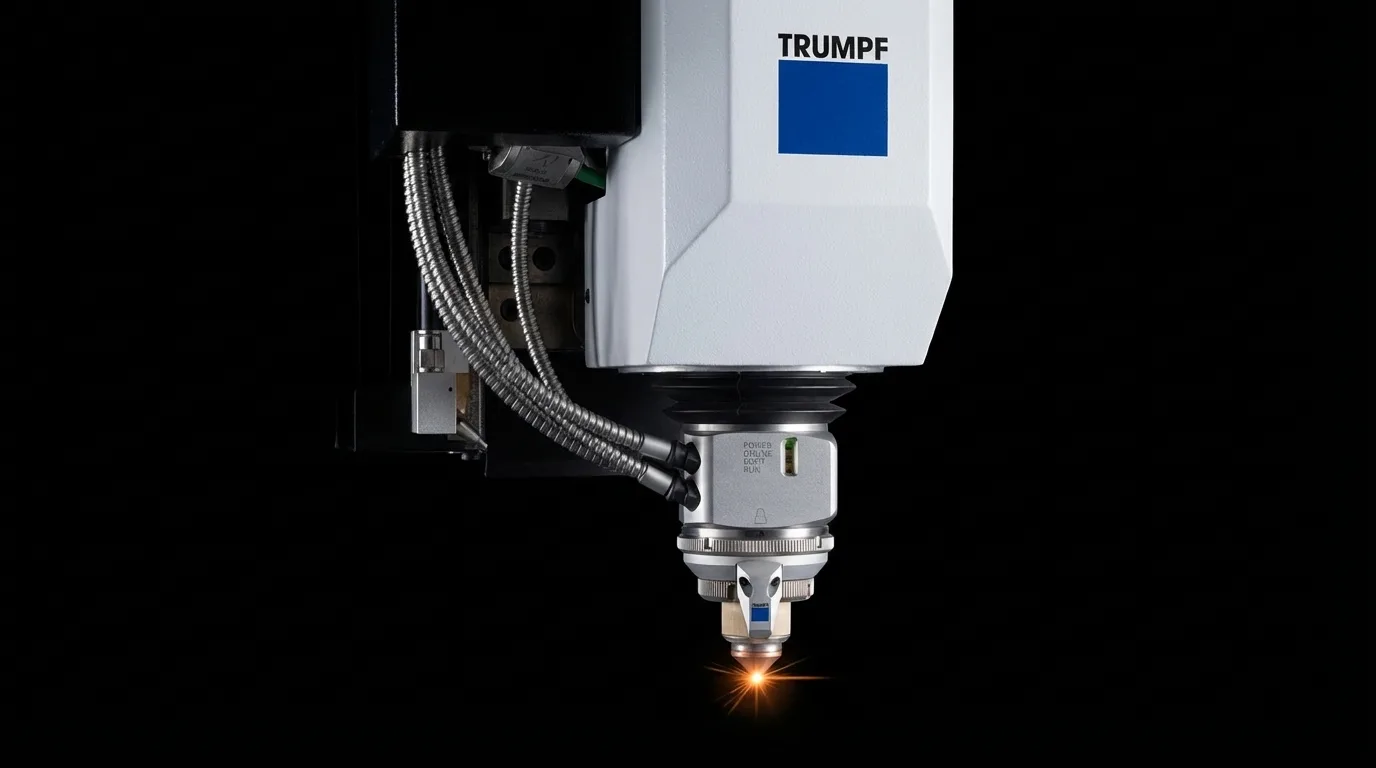
At Xeon NC, the lineage becomes direct. A digital model becomes a toolpath. A fiber laser concentrates energy into a tiny controlled point. The beam moves. Material becomes geometry. No dedicated cutting die is required, which means one prototype and a production run begin with the same essential act: send the right file to the light.
The lesson is larger than the laser. Foundational technologies do not always arrive with an obvious market attached. Sometimes humanity discovers a new capability first and spends decades learning how much of the world it can remake.
Put a tool made of light to work.
Upload a design for an instant quote. Prototype or production, the cutting geometry lives in your file — not in a dedicated tool.
Start building →