01 / SPEED
Shorter feedback loops
Move from CAD to physical evidence without building the schedule around an ocean crossing.
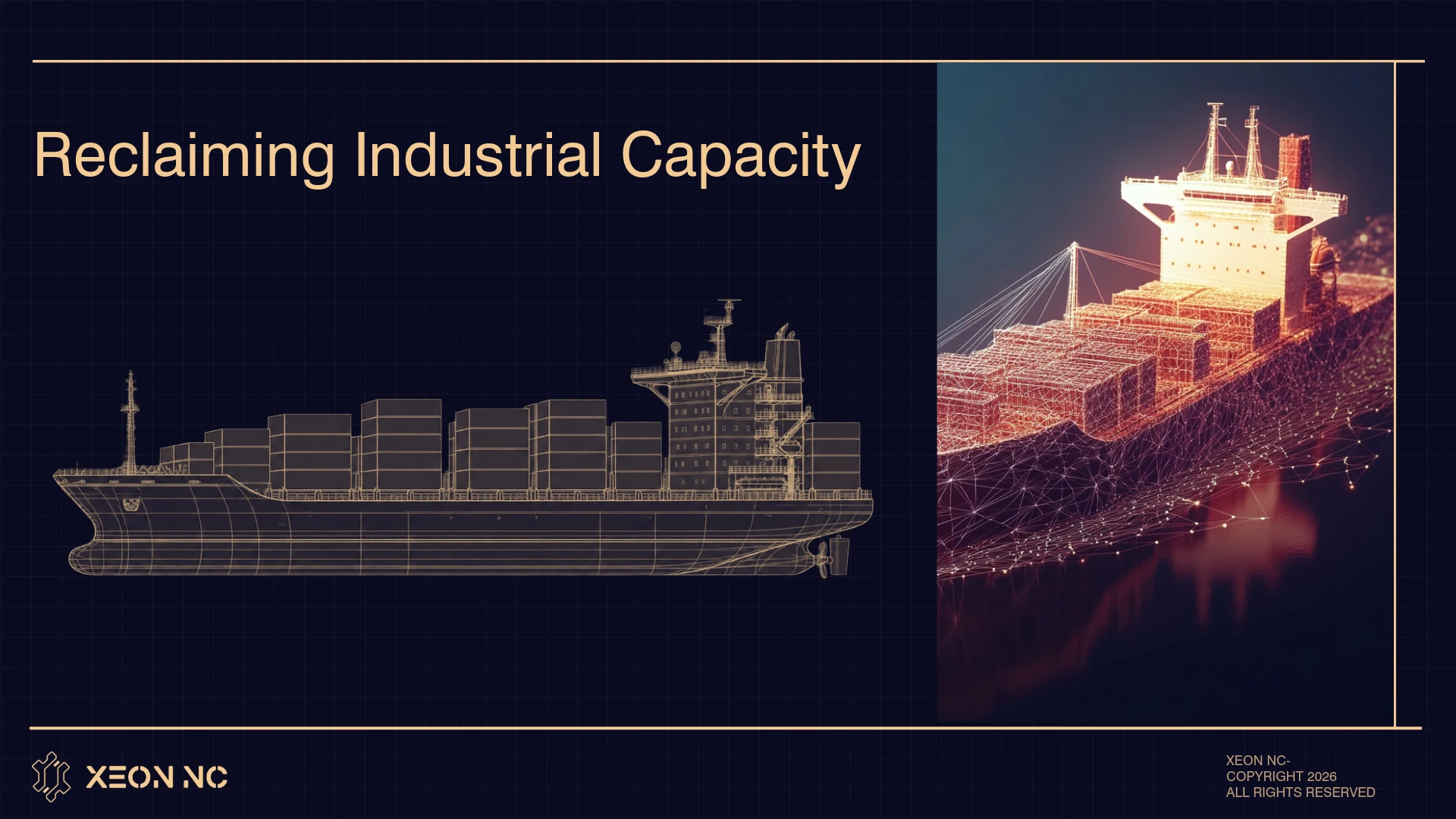
Move from CAD to physical evidence without building the schedule around an ocean crossing.
Reduce the inventory, safety stock, and cash tied up between purchase order and usable parts.
Keep communication, revisions, documentation, and production response closer to the engineering team.
Every domestic order exercises the machines, software, suppliers, and skills America needs to keep.
A company that can turn a design into a dependable physical part has more than a supplier. It has options.
Manufacturing capacity is the combined strength of machines, material, process knowledge, software, quality systems, skilled people, and responsive suppliers. When those capabilities are close to the engineering team, a company can test ideas sooner, correct problems faster, and respond to demand with less friction.
For work historically sourced through China or Mexico, choosing a U.S. production path with Xeon NC is a way to bring that capability back inside a shorter, more visible system. The benefit is not a flag on a box. It is the operating advantage that comes from proximity.
Each domestic order exercises the industrial base. It keeps tooling productive, strengthens material demand, develops manufacturing knowledge, and makes the next U.S.-built product easier to launch.
The lowest quoted unit price is not automatically the lowest-cost path to a usable part.
NIST's Manufacturing Extension Partnership describes total cost of ownership as the full set of visible and hidden costs across acquisition, transportation, storage, finance, transactions, and supply-chain activity. Its reshoring guidance emphasizes that acquisition price can be only one part of the decision.
Packaging, inland movement, ocean or cross-border transport, insurance, temporary storage, and final delivery all belong in the comparison.
Long replenishment paths can tie up cash in transit and require more safety stock before the part creates value.
Supplier search, negotiation, order control, translation, time zones, import administration, and exception handling consume internal time.
The useful measure includes the speed and cost of containment, replacement, rework, and engineering response when a problem appears.
A slow physical feedback loop can keep an old design in motion after the engineering team is ready for the next revision.
Flexibility, delivery confidence, reputation, and the ability to recover from disruption are economic factors even when they are absent from a unit quote.
The U.S. Department of Commerce's SelectUSA resources likewise point manufacturers toward a total-cost framework when comparing production locations. The practical question is not, “Where is the piece price lowest?” It is, “Which path creates the best reliable business outcome?”
Hardware improves when reality can answer the engineer quickly.
A shorter loop does more than save calendar time. It improves the quality of decisions. Teams can run more learning cycles before a launch, discover manufacturability issues earlier, and avoid scaling an assumption that the physical part would have disproved.
The closer the people defining the part are to the people making it, the easier it is to preserve design intent.
This is not an argument against the skill of manufacturers in China, Mexico, or anywhere else. It is the positive case for what an American company gains when the production loop is shorter, more legible, and easier to reach.
Resilience is the ability to keep moving when forecasts, designs, demand, or transportation conditions change.
NIST MEP's current reshoring guidance says bringing manufacturing closer to home can reduce risk and improve responsiveness. That advantage becomes real when a team needs to change quantity, replace a component, address a quality issue, or accelerate a program without waiting for a long replenishment cycle to complete.
Reclaiming capacity is not only a Fortune 500 project. It starts wherever a serious design needs to become real.
Use Xeon for precise cut, formed, or machined components, then weld, assemble, install, and service the final system in your own shop.
Order the quantity the design has earned, run another revision, and grow volume without an early overseas production commitment.
Support prototypes, fixtures, first articles, overflow, repeat work, documented programs, and a domestic source that can grow with the product.
The quantities differ. The standard should not. Every customer benefits from clear pricing, capable equipment, responsible review, traceable requirements, and a manufacturing path that respects the CAD.
Domestic manufacturing creates the most value when it is as easy to access as the global sourcing path it replaces.
The strongest onshoring program begins with a part where proximity creates obvious operating value.
Choosing Xeon NC can shorten the design-to-part feedback loop, reduce logistics and inventory complexity, improve communication and production visibility, support U.S. documentation requirements, and provide a scalable domestic path from one prototype through production.
A piece price alone does not show total cost. Compare freight, insurance, duties, transaction effort, inventory in transit, safety stock, quality response, rework, schedule risk, and the value of faster engineering changes.
Yes. Xeon NC has no minimum order, so you can begin with one CAD-ready part, validate the result, and expand domestic sourcing at a controlled pace.
Yes. Upload a supported CAD file and request a review for manufacturability, materials, processes, tolerances, finishes, certifications, and other production requirements.
Yes. A Xeon NC applications engineer can look at your part requirements, quantities, production path, documentation, and the best place to begin.
Xeon NC can help source material with mill certifications for jobs requiring USA-sourced stock when you provide the exact governing clause and documentation requirements before material is purchased.
Start with a CAD-ready part where lead time, communication, inventory, revision speed, or quality response creates meaningful value. Quote a prototype or first article, validate the process, then expand to repeat work and production.
Upload your CAD for an instant quote. Start with one prototype, validate the U.S. production path, and scale the work that creates the greatest value.
Upload Parts & Get a Quote