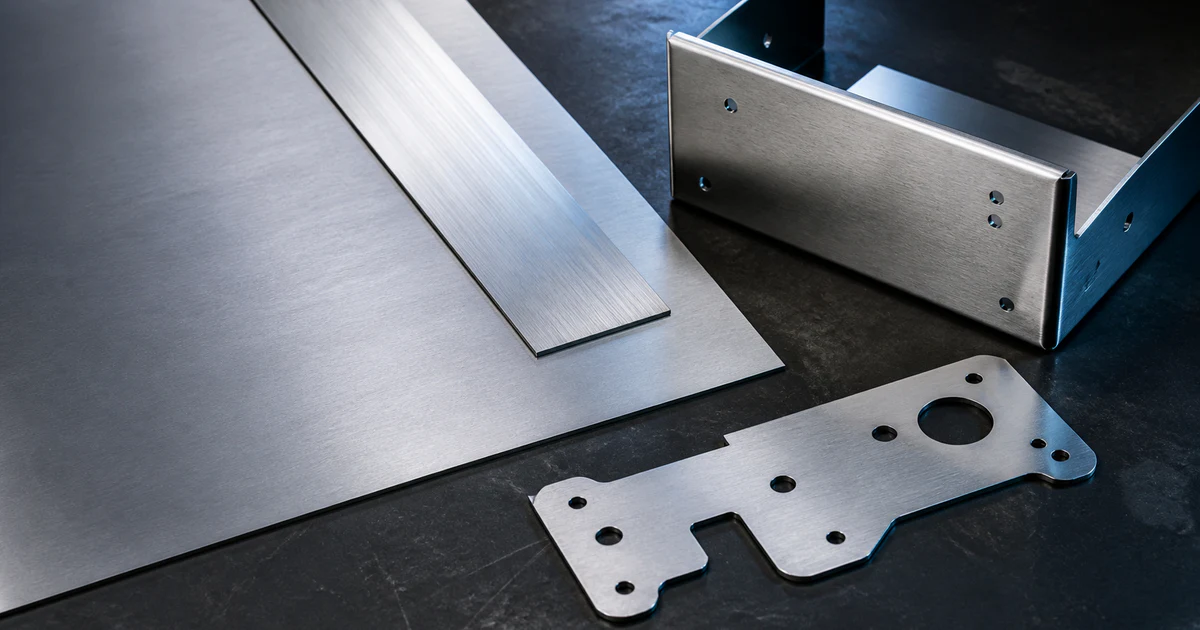
Stainless is a family of steels, not one corrosion-proof material. The right grade is the one that survives the real environment and can still be cut, formed, joined, finished, certified, and purchased on schedule.
A practical selection sequence begins with chlorides and chemicals, temperature, crevices and deposits, cleaning practice, required strength, forming severity, welding, appearance, magnetic response, product specification, and availability. For an indoor enclosure or food-contact machine guard, 304L may be the right baseline. A chloride-bearing washdown, coastal installation, or chemical process can move the discussion to 316L or beyond. High strength can move it to cold-worked 301 or 17-4 PH, but each changes the manufacturing plan.
Decision pathChoose the service constraint first
01
General-purpose formed and welded sheet?
Start with 304 or 304L. Confirm the actual atmosphere, cleaning chemistry, finish, and drawing requirements.
02
Chloride splash, salt, coastal air, or harsher chemicals?
Evaluate 316 or 316L. Molybdenum improves pitting and crevice resistance, but does not make the part seawater-proof.
03
Spring behavior or high strength from cold work?
Evaluate 301 or a specified cold-worked austenitic condition under ASTM A666/A666M. Forming sequence and property direction matter.
04
Low cost, magnetic response, or exhaust-temperature service?
Ferritic 430 or stabilized 409 may fit. Their corrosion behavior, weldability, and forming limits differ from 304.
05
High final strength with controlled heat treatment?
Consider 17-4 PH sheet under ASTM A693. Design, form, and procure around the solution-treated and aged condition.
"Marine grade" is shorthand, not a guarantee316/316L is more resistant to chloride pitting than 304/304L, but chloride level, temperature, wet time, deposits, crevices, residual stress, finish, and cleaning can still cause attack. Specify the environment, not just the nickname.
02 / Grade Map
Eight grades, eight different jobs.
The common U.S. type number is useful, but the UNS designation, product specification, condition, thickness, finish, and mill test report complete the identity.
201
UNS S20100 / Austenitic
Lower-nickel value grade
Manganese and nitrogen replace part of the nickel used in 300-series grades. Useful in selected appliances, transport, and interior products; it work-hardens rapidly and is not a universal corrosion-equivalent substitute for 304.
Low nickelHigh work hardening
301
UNS S30100 / Austenitic
Cold-work strength
High work-hardening capacity supports springs, clips, belts, and lightweight structures. Order the correct temper or cold-worked condition and align forming, rolling direction, fatigue, and final properties with the drawing.
SpringsASTM A666
304 / 304L
UNS S30400 / S30403
The general-purpose baseline
Widely available, formable, weldable, and corrosion resistant in many indoor, food, architectural, and industrial environments. The low-carbon L grade reduces sensitization risk during welding and thermal exposure.
General sheetWeldableAvailable
316 / 316L
UNS S31600 / S31603
Chloride-resistance upgrade
Molybdenum improves pitting and crevice-corrosion resistance. Common in chemical, pharmaceutical, food, coastal, and washdown equipment where 304 has insufficient margin.
MolybdenumChloridesWashdown
321
UNS S32100 / Ti-stabilized
Elevated-temperature stability
Titanium stabilization improves resistance to intergranular corrosion after thermal exposure. Used in exhaust, stack, pressure, and high-temperature fabricated equipment when the service and code support it.
StabilizedElevated temp
409
UNS S40900 / Ferritic
Exhaust and heat systems
A lean, stabilized ferritic grade associated with automotive exhaust and heat-handling applications. It is magnetic and can show surface rust in atmospheric exposure even while retaining useful system life.
ExhaustMagnetic
430
UNS S43000 / Ferritic
Nickel-free general ferritic
A common magnetic grade for appliances, trim, cabinets, and mildly corrosive service. Cost and polishability can be attractive, but weldability, toughness, drawability, and chloride resistance do not match 304.
MagneticAppliance
17-4 PH
UNS S17400 / Precipitation hardening
Strength after aging
Combines useful corrosion resistance with high strength developed by precipitation heat treatment. Sheet is commonly formed in the solution-treated condition, then aged to a specified condition such as H900 or H1150 under a qualified plan.
ASTM A693Condition matters
Do not identify stainless with a magnetAnnealed 300-series austenitic sheet usually has low magnetic response, but cold forming and weld structure can increase it. Ferritic 409/430 and 17-4 PH are magnetic. Use markings, traceability, MTR chemistry, PMI when required, and the purchase specification—not a shop magnet—to verify grade.
03 / 304 vs. 316
The common choice is about environment, not prestige.
304 is the economical default for a broad range of fabricated sheet. 316 adds molybdenum to gain chloride resistance. The L suffix manages carbon, not general corrosion ranking.
Attribute
304 / 304L
316 / 316L
Design meaning
Corrosion baseline
Broad general-purpose resistance
Improved pitting and crevice resistance
316 earns its premium when the actual chloride or chemical exposure needs it.
Key alloying
Chromium-nickel austenitic
Chromium-nickel-molybdenum austenitic
Molybdenum is the principal reason 316 outperforms 304 in many chloride environments.
Forming
Excellent in annealed sheet
Excellent in annealed sheet; loads may differ
Both work-harden; qualify bend tables, springback, finish protection, and grain direction.
Welding
Commonly welded; 304L helps manage sensitization
Commonly welded; 316L helps manage sensitization
Use the qualified WPS, correct filler, purge where needed, and post-weld cleaning for service.
Coastal, washdown, pharmaceutical, chemical, chloride-bearing service
"Typical" is not acceptance. Review chemical concentration, temperature, crevices, and cleaning.
Cost / supply
Usually lower cost and widest stock
Usually higher cost due to alloy content
Stock thickness, finish, origin, certification, and quantity can matter more than the nominal alloy delta.
What the L really means
304L and 316L set a lower carbon limit than their standard-carbon counterparts. That helps reduce chromium-carbide sensitization during welding or other exposure in the sensitizing temperature range. It does not automatically improve strength, finish, pitting resistance, or fabrication quality. Material sold as dual-certified 304/304L or 316/316L is common, but the certified chemistry and mechanical results on the MTR—not a catalog habit—establish whether the heat satisfies both callouts.
04 / U.S. Specifications
"304 stainless sheet" is not a complete material callout.
The product standard and general requirements control chemistry, mechanical properties, dimensions, finish, testing, and ordering information. The customer drawing then adds the part-specific requirements.
Specification
Scope
Common use
When it belongs
ASTM A240/A240M-26
Chromium and chromium-nickel stainless plate, sheet, and strip
304/L, 316/L, 321, 409, 430 and many others
General and pressure-vessel flat product when the governing design allows it.
ASTM A480/A480M-25b
General requirements for flat-rolled stainless and heat-resisting steel
Works with product specifications including A240, A666, and A693; the product spec prevails if they conflict.
ASTM A666/A666M-24
Annealed or cold-worked austenitic sheet, strip, plate, and flat bar
301 and other specified austenitic cold-work conditions
When controlled cold-worked strength or temper is part of the design.
ASTM A693-24
Precipitation-hardening stainless plate, sheet, and strip
17-4 PH and related PH grades
When properties are developed by the specified precipitation heat treatment.
ASTM A380/A380M-25
Cleaning, descaling, pickling, and passivation practice
Fabricated assemblies and systems
When a controlled stainless cleaning and restoration route must be selected and verified.
ASTM A967/A967M-25
Chemical passivation treatments and verification tests
Nitric, citric, and electrochemical processes
When the drawing or purchase order requires a defined passivation treatment and acceptance test.
A useful industrial drawing callout
STAINLESS STEEL SHEET, ASTM A240/A240M-26, TYPE 304L, UNS S30403, 0.060 IN NOMINAL, THICKNESS TOLERANCE PER ASTM A480/A480M, 2B FINISH, PVC PROTECT FACE A, MTR REQUIRED
Grade
TYPE 304L / UNS S30403
Product spec
ASTM A240/A240M-26 — confirm the revision required by contract
Thickness
EXACT DECIMAL THICKNESS; USE THE APPLICABLE A480 TOLERANCE OR STATE THE ENGINEERED REQUIREMENT
Finish / face
2B; PVC PROTECT FACE A; STATE FINISH DIRECTION AND COSMETIC STANDARD WHEN NEEDED
Documentation
MTR, HEAT/LOT TRACEABILITY, ORIGIN AND DOMESTIC-SOURCE REQUIREMENTS IF CONTRACTUALLY REQUIRED
Call out decimal thickness, not gauge aloneStainless gauge tables differ from carbon steel, galvanized steel, and aluminum. A decimal dimension and governing tolerance prevent an avoidable material mismatch.
05 / Mill & Polished Finishes
Finish is functional, cosmetic, and directional.
Surface finish changes appearance, cleanability, friction, reflectivity, and sometimes corrosion performance. Put the finish, protected face, grain direction, acceptable variation, and post-fabrication restoration on the drawing.
Hot rolled
No. 1
Annealed and descaled
A rougher, dull industrial finish common on hot-rolled plate and heavier flat product. Appropriate when function matters more than a uniform decorative face.
Cold rolled
2D
Smooth matte finish
Cold rolled, heat treated, pickled or descaled, with a matte appearance. Useful for deep drawing or applications that do not require the brighter 2B surface.
Cold rolled
2B
The common sheet baseline
A 2D-type surface followed by a light final cold roll using polished rolls. Smooth, moderately reflective, and widely stocked for general fabricated stainless sheet.
Bright annealed
BA
Bright, highly reflective mill finish
Produced by heat treatment in a controlled atmosphere. It is brighter than 2B but is not automatically a No. 8 mirror polish.
Polished
No. 4
Directional brushed finish
The familiar architectural and food-equipment look. Specify reference sample or roughness where appearance matters, plus grain direction across parts and assemblies.
Polished
No. 8
Mirror-polished finish
A highly reflective mechanically polished surface. Flatness, distortion, weld blending, handling, and batch-to-batch appearance need explicit acceptance criteria.
Finish names do not define every appearance variableTwo nominal No. 4 sheets can differ in abrasive, roughness, color, direction, and reflectivity. For visible assemblies, approve a physical sample or measurable appearance standard and keep all cosmetic parts in a controlled finishing route.
06 / Laser Cutting & Edges
Cut quality must match what happens next.
Stainless is routine fiber-laser work, but the right assist gas and acceptance limit depend on whether the edge will remain visible, be welded, be passivated, contact product, or receive a coating.
01 / Nitrogen fusion cut
Oxide-free edge
Inert nitrogen ejects the molten metal and shields the kerf from air. The result is an oxide-free cut edge that usually needs no oxide removal before welding, finishing, or corrosion-sensitive service, assuming burr and dross are acceptable.
Reactive or mixed-gas cutting can be economical for selected thicknesses and parts, but the edge chemistry and oxide state differ from nitrogen cutting. State any oxide-removal requirement before welding, coating, passivation, or cosmetic finishing.
PVC or laser film helps preserve a 2B, BA, or No. 4 face during cutting and forming. The laser process must be qualified for the film type and side; remove trapped, burned, or aged film before welding and final cleaning.
DRAWING: FACE A · FILM TYPE · FILM SIDE · REMOVAL STAGE · RESIDUE LIMIT
04 / Deburr & edge round
Finish the edge for service
A laser-cut edge may still need dross removal, burr control, a broken edge, or a defined radius for handling, coating, fatigue, hygiene, or appearance. Use dedicated or verified clean abrasives to avoid embedding carbon steel.
Small holes, narrow webs, acute corners, shared cut lines, and dense heat input need machine- and thickness-specific DFM review. Do not transfer a mild-steel minimum feature rule directly to stainless without checking process capability and the required edge condition.
07 / Bending & Forming
Work hardening and springback shape the bend plan.
Annealed austenitic stainless forms well, but it strengthens rapidly as it deforms. That raises forming load, increases springback, and makes the actual heat, grain direction, radius, tooling, and sequence important.
Annealed 304L is not the same forming job as half-hard 301 or aged 17-4 PH.
02
Plan springback
Program and tooling must account for grade, yield strength, thickness, die opening, angle, and bend direction.
03
Respect the rolling direction
For tight or critical bends, mark grain direction and qualify the least favorable orientation.
04
Protect the finish
Use clean tooling, suitable protective media, controlled handling, and a finish-restoration plan for visible faces.
Do not publish one universal stainless radius
Minimum inside radius varies with grade, condition, thickness, bend angle, grain orientation, edge quality, tooling, lubrication, temperature, and cosmetic requirement. A shop bend table based on representative material and the actual press-brake system is more defensible than a universal "1T" rule. When fracture, fatigue, hygiene, or cosmetic performance matters, validate the purchased material and worst bend.
17-4 PH condition controls formabilityASTM A693 material generally develops its final properties by precipitation heat treatment. Severe forming belongs in the solution-treated condition unless an approved design and procedure say otherwise. The aging condition also changes final strength, ductility, corrosion response, and dimensional movement.
08 / Welding & Joining
Control heat, shielding, filler, and the root.
Austenitic stainless is readily weldable, but a sound bead is not automatically a corrosion-ready surface. Weld procedure, shielding, purge, fit-up, heat input, distortion, filler, and post-weld cleaning belong to the same plan.
01 / Qualified WPS
Match grade and service
Use a welding procedure qualified for the base metal, thickness, joint, process, position, filler, and code. 308L-family filler is common for 304L and 316L-family filler for 316L, but the approved WPS and service requirements control.
CONTROL: BASE METAL · FILLER · GAS · HEAT INPUT · INTERPASS · TRAVEL · REPAIR
02 / Root purge
Protect critical back sides
In piping, sanitary, pharmaceutical, and corrosion-critical joints, purge the root to limit oxidation and maintain a clean internal surface. Provide gas access, venting, oxygen acceptance, and inspection access in the joint design.
ROOT: PURGE DAM · FLOW · OXYGEN LIMIT · VENT · COLOR / ROUGHNESS ACCEPTANCE
03 / Distortion control
Low conductivity concentrates heat
Stainless moves under weld heat. Use balanced joint design, fit-up control, fixturing, sequence, tacks, controlled heat input, and realistic tolerances. Do not force a thin welded enclosure into flatness after the fact without a plan.
PLAN: JOINT GAP · TACKS · SEQUENCE · FIXTURE · SHRINKAGE · FINAL DATUMS
04 / Post-weld restoration
Remove tint when service requires it
Heat tint indicates an altered oxide and chromium-depleted region beneath it. Corrosion-critical, sanitary, and visible work may require mechanical cleaning, pickling, electropolishing, or another qualified restoration route before passivation.
Use dedicated stainless brushes, clean abrasives, separated work areas where practical, and protected storage. Forks, tables, shot, grinding dust, and shared tools can embed free iron that later appears as rust. If the surface is critical, specify cleaning and a free-iron verification method rather than relying on appearance alone.
09 / Corrosion, Cleaning & Passivation
Passivation is the last controlled step, not a repair shortcut.
Stainless resists corrosion through a chromium-rich passive film. Fabrication must remove damaging contamination and scale, restore the surface appropriate to service, and avoid geometry that traps the environment.
Surface restorationDifferent problems need different processes
01
Oil, dirt, adhesive, shop residue?
Preclean and degrease with a compatible controlled process. A passive surface cannot compensate for trapped contamination.
02
Weld scale or heavy heat tint?
Descale or pickle, or use a qualified mechanical/electrochemical restoration route. Passivation alone does not remove scale.
03
Embedded free iron?
Clean and remove the contamination, then use an agreed verification test. Prevent recurrence through tool and handling controls.
04
Final passivation required?
Specify the governing standard, treatment, rinse, handling, and verification method. ASTM A967/A967M includes nitric, citric, and electrochemical routes.
Design out corrosion traps
Grade selection cannot rescue a poor detail. Avoid unsealed lap joints, stagnant liquid pockets, uncleanable corners, wet insulation, dissimilar-metal contact without isolation, and fastener crevices that stay loaded with salt. Drain, slope, seal, ventilate, isolate, and provide cleaning access. Smooth, consistently restored surfaces generally perform better than rough, iron-contaminated ones in hygiene and atmospheric service.
Watch galvanic couples
Stainless is relatively noble in many wet systems. When coupled to aluminum, zinc-coated steel, or carbon steel, the less noble material can corrode faster. The risk depends on electrolyte, area ratio, coating damage, geometry, temperature, and wet time. Use electrical isolation, compatible fasteners, sealants, drainage, coating strategy, and a service-specific corrosion review.
Passivation does not add a thick protective coatingIt removes contamination and supports formation of the natural passive surface under the specified process. It cannot correct the wrong grade, a chloride trap, a rough contaminated weld, or an unqualified cleaning route.
10 / Drawing, RFQ & Safety Checklist
Define the material and the finished surface.
A complete stainless RFQ connects raw-stock identity, cosmetic direction, forming and welding acceptance, surface restoration, documentation, and the final inspection state.
01
Type, UNS, and product specification
Example: Type 316L, UNS S31603, ASTM A240/A240M-26. Add the required revision when contractually controlled.
02
Exact thickness and tolerance
Use decimal thickness. Reference A480 tolerance or state a justified tighter requirement and measurement method.
03
Finish, grain direction, and protected face
State No. 1, 2D, 2B, BA, No. 4, or the controlled finish; show direction and cosmetic face.
04
Condition and rolling direction
Annealed, cold-worked temper, solution treated, or aged condition changes properties and formability.
05
Cut and formed edge acceptance
Call out assist-gas restriction if necessary, burr, dross, edge break, bend radius, cracking, galling, and tooling marks.
Name the standard and process boundary. Specify free-iron, water-break, or other agreed tests when required.
08
MTR, traceability, and source clauses
State heat/lot traceability, material reports, marking, origin, domestic preference, approved supplier, and record retention.
Hot-work safety belongs in the process plan
Welding and thermal cutting stainless can produce hexavalent chromium exposure. OSHA identifies hot work on stainless as a major source of Cr(VI) exposure and requires employers to assess and control exposure under the applicable standards. Use qualified ventilation, fume extraction, work practices, PPE, respiratory protection where required, and exposure monitoring through the shop's written safety program. Grinding dust, chemicals used for pickling/passivation, compressed gases, sharp edges, and confined spaces add separate hazards.
Fabrication advice is not an EHS planFollow the current SDS, equipment instructions, chemical supplier requirements, OSHA standards, local environmental rules, and the facility's written programs. Never improvise acid cleaning, confined-space purging, or fume control.
11 / FAQ & Sources
Fast answers before the RFQ goes out.
304 or 304L is the usual first choice because it is widely available, formable, weldable, and corrosion resistant in many general environments. Confirm chemicals, chlorides, temperature, crevices, cleaning, finish, and code before release.
Choose 316L when molybdenum's added pitting and crevice-corrosion resistance is justified by chloride-bearing washdown, coastal exposure, salt, or a compatible chemical environment. 316L is more resistant, not immune.
Not automatically. Dual-certified stock is common, but the purchase order, governing code, certified chemistry, thickness, and certified mechanical properties determine acceptance. Welding and elevated-temperature service can make the carbon limit important.
Yes. Nitrogen fusion cutting is widely used for an oxide-free edge. The correct gas, pressure, nozzle, focus, speed, film handling, burr, dross, and edge criteria are machine- and thickness-specific.
No. Heavy heat tint and scale need a suitable cleaning, descaling, pickling, mechanical, or electrochemical restoration route. Passivation follows the required surface preparation; it does not replace it.
No. Ferritic 409 and 430 and precipitation-hardening 17-4 PH are magnetic. Annealed 300-series material normally has low magnetic response, but cold work and welding can increase it.
This guide is educational. It does not replace the current purchased standard, governing code, corrosion review, design allowables, qualified bend data, WPS, passivation procedure, inspection plan, or written safety program for the actual part.
From grade choice to finished surface
Ready to review your stainless part?
Send the model, drawing, material callout, finish, quantity, and end-use requirements. We can evaluate the geometry and identify the manufacturing questions that should be resolved before material is ordered.