Grade 1
UNS R50250 / Commercially pure
Maximum cold formability
The softest and most ductile common CP grade. Consider it for deep draws, severe forming, heat-exchanger plate, and corrosion service where Grade 2 strength is unnecessary.
Grade 2, Grade 5, and the grades between them—how to select, specify, cut, bend, weld, finish, and inspect titanium sheet for U.S. production.
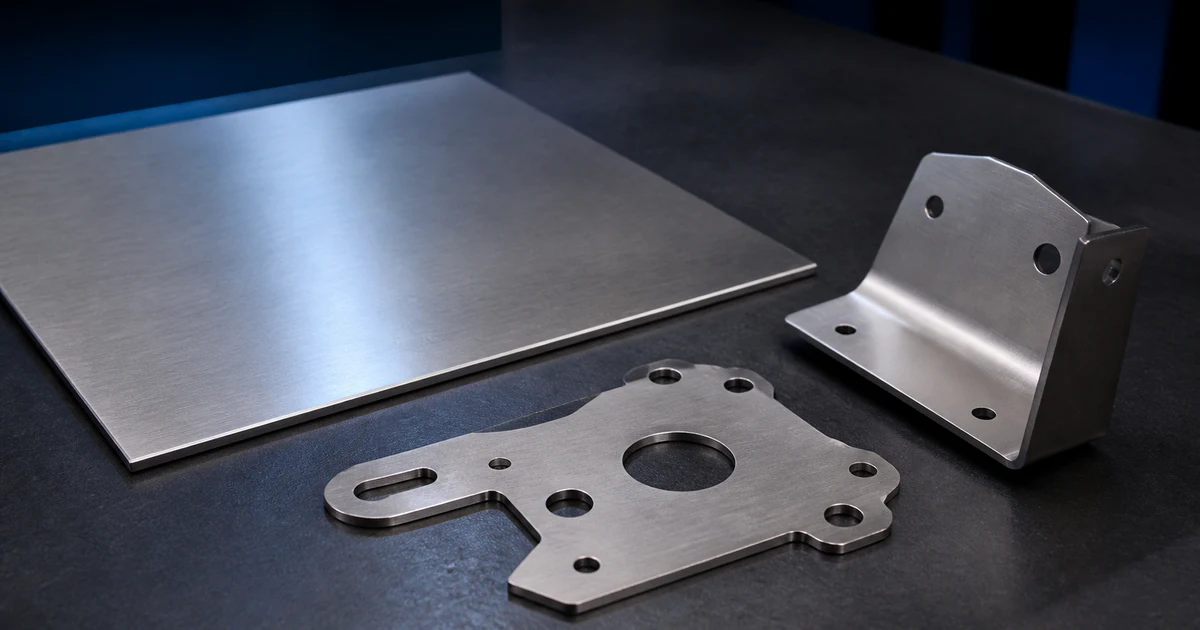
Titanium grades are not a simple ladder from “basic” to “best.” Grade 2, Grade 5, Grade 7, and Grade 23 solve different problems.
A useful selection sequence begins with environment, strength, forming severity, temperature, joining, certification, and availability. If corrosion resistance and formed sheet geometry drive the job, Grade 2 is usually the right first question. If strength-to-weight drives it, start with Grade 5—but design the bends and process around the alloy instead of treating it like stainless steel.
Grades 1–4 are commercially pure titanium. Grades 5, 7, 9, 12, and 23 use alloying or tighter interstitial limits to change strength, corrosion behavior, or toughness.
The softest and most ductile common CP grade. Consider it for deep draws, severe forming, heat-exchanger plate, and corrosion service where Grade 2 strength is unnecessary.
The practical balance of corrosion resistance, availability, weldability, strength, and formability. Common in chemical equipment, marine hardware, heat exchangers, architectural work, and general titanium sheet assemblies.
A less common middle step: higher strength than Grade 2 with less formability. It can fit pressure or corrosion equipment when a CP chemistry and extra design stress are both useful.
The highest-strength commercially pure grade in this group, with the least room-temperature formability. Used when CP corrosion behavior must be retained while strength takes priority over tight bends.
The widely used alpha-beta alloy for aerospace structures, high-performance equipment, motorsport, and loaded brackets. It is far stronger than Grade 2 but demands generous radii, higher forming loads, and more springback control.
Palladium enhances resistance in reducing environments and aggressive crevice conditions while mechanical behavior remains broadly similar to Grade 2. It is a specialty chemical-process choice, not a routine upgrade.
More strength than CP titanium with better cold workability than Grade 5. Known for aerospace hydraulic tubing, honeycomb structures, sporting goods, and applications that need a formable alpha-beta alloy.
A lean alloy with greater strength than Grade 2 and improved resistance in hot brines, crevices, and selected acid service. Common logic: thinner chemical-process sections when the corrosion review supports it.
Lower interstitial limits improve ductility and fracture-related performance compared with standard Grade 5. Used in fracture-critical, cryogenic, aerospace, and medical contexts—but only the correct governing specification establishes compliance.
Grade 2 wins when the part must form, weld, and resist corrosion economically. Grade 5 wins when the part must carry more load per pound.
*Representative minimum values for commonly specified annealed ASTM B265 sheet. Thickness, condition, specification revision, and direction can change requirements. Use the current purchased standard and certified mill test report for design acceptance.
The U.S. specification establishes product form, chemistry, mechanical properties, condition, tolerances, tests, and documentation. Pick it before the material is ordered.
For aerospace, medical, nuclear, defense, or pressure work, approved supplier status, DFARS or domestic-source clauses, country of melt, lot segregation, NDT, special-process approvals, and records retention can be separate contractual requirements. Do not infer them from the alloy name.
A clean-looking contour is not the only acceptance criterion. The edge may become a weld joint, fatigue surface, medical surface, or merely a cosmetic perimeter—and those are different jobs.
Modern solid-state lasers can cut titanium sheet. Use machine-specific titanium parameters, controlled fume extraction, and an assist gas selected for the final edge requirement. Argon is the conservative choice for critical titanium edges because hot titanium strongly absorbs oxygen and nitrogen.
Abrasive waterjet avoids a laser heat-affected edge and can suit thick plate, temperature-sensitive geometry, or downstream critical surfaces. Expect slower processing, taper/striations, abrasive management, and a possible finishing allowance.
Annealed industrial titanium can be sheared using capacity logic similar to 300-series stainless. Clearance, sharp tools, edge cracking, galling, and protected surfaces matter. Deburr before forming so an edge defect does not become a crack starter.
Use dedicated, clean tooling and adequate coolant where the process calls for it. Overheated abrasive cuts or shared ferrous tooling can contaminate the surface. Remove visibly burned or embedded material before welding or critical service.
Titanium’s elastic modulus is roughly half that of steel, so it springs back substantially after forming. Grade 5 adds high yield strength and much lower cold-forming latitude.
Grade 2 needs more radius than common mild steel; Grade 5 needs much more.
TIMET notes roughly 15–25° loss in included angle may occur, with stronger alloys springing back more.
Bend orientation affects ductility. Mark rolling direction and qualify the worst orientation.
Titanium galls. Use suitable lubrication, smooth tooling, and controlled forming speed.
T is material thickness. Values above are the room-temperature reference reproduced in TIMET’s design and fabrication handbook for annealed sheet/plate associated with ASTM B265. TIMET also notes that achievable shop minima may be about half the specification figure under suitable conditions. Treat neither statement as a tooling guarantee: test the purchased heat, thickness, rolling direction, die opening, punch radius, bend angle, and surface condition.
Elevated temperature improves ductility and reduces springback. TIMET identifies roughly 400–600°F (204–316°C) as a useful warm-forming range for unalloyed grades and Grade 12. Its Grade 5 data show progressively smaller bend radii as temperature rises, with 1200°F (649°C) eliminating much of the springback in the cited condition. That does not make field heating acceptable: temperature uniformity, dwell, tooling, atmosphere, oxidation, scale removal, heat treatment, and property verification require a controlled procedure.
Molten titanium and the hot heat-affected zone absorb oxygen, nitrogen, and hydrogen. Cleanliness and complete inert shielding are structural requirements, not cosmetic preferences.
GTAW/TIG is common for sheet. Welding-grade argon is the usual primary gas; helium or mixtures may be used under an approved procedure. Gas lenses and adequate cup coverage help maintain smooth, nonturbulent protection.
The solidified bead and face-side HAZ remain reactive while hot. TIMET calls for protection until the material falls to about 800°F (427°C) or lower. A trailing shoe extends inert coverage behind the torch.
Back-purge the root and backside HAZ. Joint design must provide purge access and inspection access. A bright face cannot prove that an inaccessible root was protected.
Use clean, dedicated tools and lint-free handling. Remove oxide, grease, burrs, and embedded particles. Avoid chlorinated cleaning residues. Keep filler wire inside the shield; clip any contaminated end before re-entry.
A bright silver bead generally indicates effective shielding when preparation and procedure were correct. Straw and blue colors indicate increasing surface oxidation; gray, chalky, or white deposits signal severe contamination. Acceptance cannot be reduced to a universal color chart—critical work follows the drawing, code, procedure qualification, hardness/NDT requirements, and customer standard.
Bolts and rivets avoid fusion contamination but introduce bearing, fretting, preload, isolation, and galvanic questions. Titanium is electrically noble in many wet couples; it can accelerate corrosion of aluminum or carbon steel joined to it. Use compatible fasteners, nonconductive isolation where appropriate, sealed interfaces, drainage, and a corrosion review for the actual electrolyte.
Titanium’s thin, adherent oxide reforms in oxygen-bearing environments and drives its corrosion resistance. Fabrication should avoid conditions that damage the surface or trap an environment the selected grade cannot tolerate.
Common sheet arrives with a uniform gray, descaled or pickled surface. It is functional, not guaranteed cosmetic. State directional finish, roughness, or protected face separately when appearance matters.
Brushing and blasting can create a consistent matte look, but contaminated belts, steel media, or dirty cabinets can embed foreign metal. Use titanium-dedicated or verified clean media and define the appearance standard.
Titanium anodizing changes oxide thickness to create interference colors. Color is sensitive to voltage, surface prep, alloy, lighting, and viewing angle; it is not a substitute for a wear coating unless a qualified functional process says otherwise.
Titanium pickling often uses aggressive acid chemistry, including hydrofluoric/nitric systems. It belongs with trained personnel, controlled baths, ventilation, PPE, waste treatment, and a qualified process—not a shop-floor improvisation.
Titanium performs exceptionally in seawater and many oxidizing environments, but “corrosion-proof” is not an engineering property. Grade selection must consider concentration, temperature, pH, oxidizing potential, crevices, deposits, flow, galvanic contact, residual stress, and upset conditions. Grade 7 and Grade 12 exist because Grade 2 is not universal.
A titanium RFQ should define the raw material, the condition at every critical edge and bend, and the records expected at delivery.
Grinding dust, dry chips, fines, and hot particles can burn intensely or create an explosion hazard when dispersed. Design the process around combustible-metal controls.
OSHA specifically documents fatal titanium dust incidents and treats combustible dust as a fire and explosion hazard. Dust-producing operations need a process-specific hazard analysis, compatible collection equipment, housekeeping, bonding/grounding where applicable, separation from incompatible metal dusts, ignition control, and an emergency plan based on the current SDS, equipment instructions, and applicable fire code.
Laser and thermal cutting also require fume extraction and eye, skin, and fire protection appropriate to the equipment. Chemical pickling adds severe acid exposure and environmental controls. Fabrication guidance never replaces the shop’s written safety program.
This guide is educational and does not provide design allowables, a welding procedure, a medical-device qualification, or a safety plan. Verify the current governing code/specification, mill certification, customer requirements, and process qualification for the actual part.
Send the model, drawing, material callout, quantity, and end-use requirements. We can evaluate the geometry and identify the manufacturing questions that should be resolved before material is ordered.