01 / Case study
< 1 weekCustomer CAD became manufactured sheet metal parts shipped from Xeon NC in under one week.
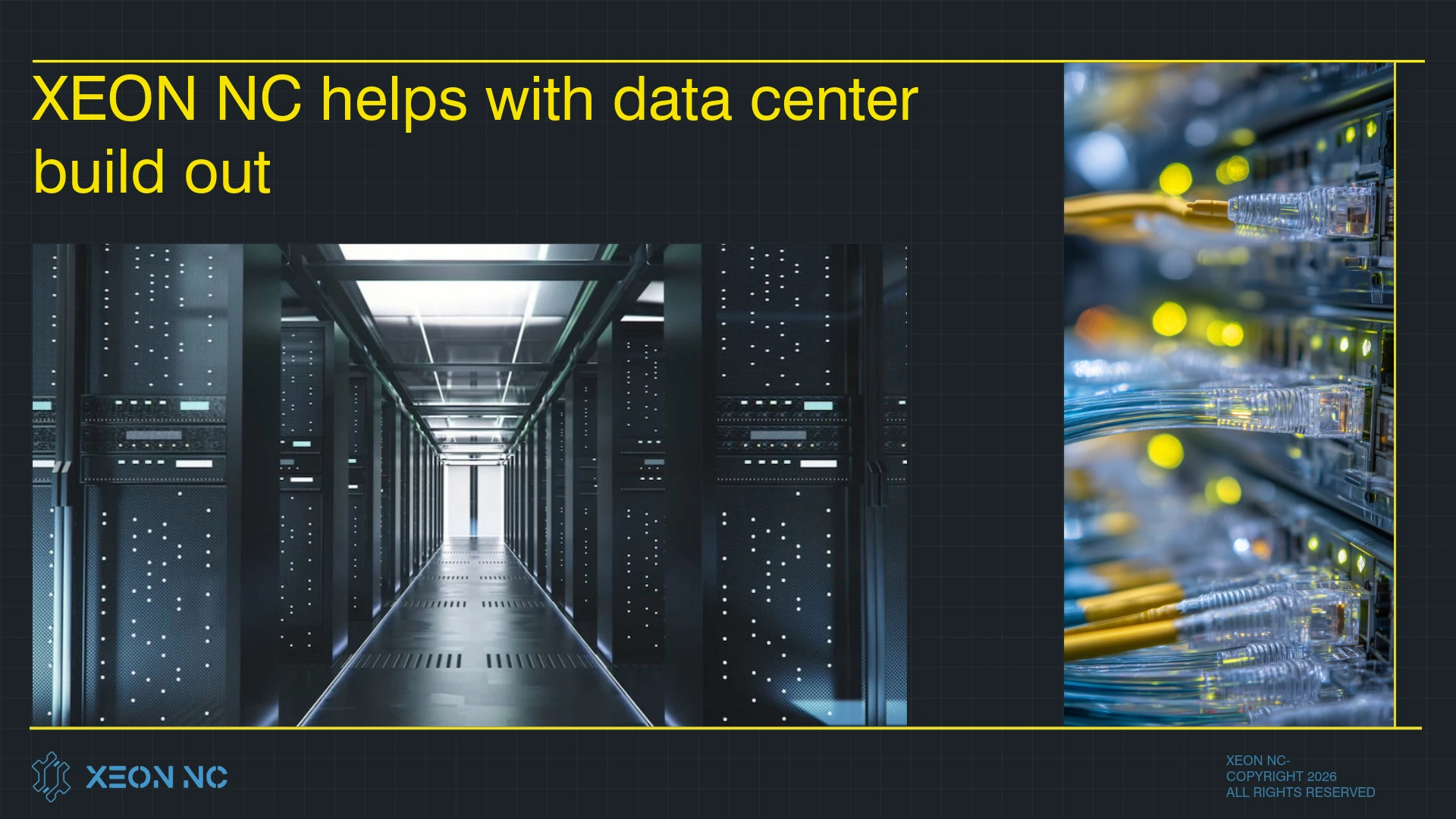
Customer CAD became manufactured sheet metal parts shipped from Xeon NC in under one week.
Planned U.S. data centers in Pew Research Center's February 2026 dataset.
Capacity under construction across CBRE's primary North American markets at year-end 2025.
Start with one prototype or first article, then scale the parts the program validates.
Every megawatt of compute begins as a construction program: land, power, cooling, structure, equipment, and thousands of parts that have to exist before the first workload can run.
The data center is often described through processors, networking, and software. But deployment stops when a panel is missing, a bracket does not fit, a guard needs revision, or a mounting component is still moving through a conventional RFQ queue.
This makes sheet metal more than a commodity. It is part of the infrastructure layer that converts engineering intent into an operating facility.
A customer building for data center construction needed sheet metal parts on a schedule shaped by the field, not by a traditional quoting cycle.
The customer brought the design to Xeon NC. The parts moved through the required manufacturing path, were completed, packed, and shipped to the customer in under one week. The result was not only a fast order. It was schedule risk converted into forward motion.
A digital part definition gave the order a structured starting point for configuration, review, and release.
The quote and production path stayed connected, reducing the delay between a purchasing decision and work beginning.
The manufactured sheet metal parts left Xeon NC in under one week, ready to enter the customer's buildout workflow.
The map is no longer only Northern Virginia and Silicon Valley. New capacity is moving through the South, Midwest, West, and into communities that have never hosted this class of infrastructure.
Pew Research Center found more than 1,500 U.S. data centers in development as of February 19, 2026. In its dataset, 67% of planned projects were in rural areas and three-quarters were in the South or Midwest. Virginia, Texas, Georgia, Illinois, and Arizona led the states shown for planned development.
Pew's “planned” category combines projects listed as under construction, planned, or land banked. The source table includes only the 15 states with the largest combined operating-and-planned markets; gray states should not be read as zero. Geography is rendered from the published U.S. Atlas state topology.
The chart is a count of sites, not a measure of megawatts, floor area, project value, or construction certainty. It shows how widely the demand for physical infrastructure has spread—and why a responsive supplier cannot be tied to one local market.
CBRE's H2 2025 primary-market data describes an infrastructure system operating with almost no slack.
At this rate, time lost at the component layer propagates. A late part can hold an assembly. A held assembly can block a subsystem. A blocked subsystem can put pressure on commissioning. The practical response is not simply more inventory. It is a manufacturing system that can react to the current design and the current schedule.
Sheet metal appears throughout the facility because infrastructure needs to mount, route, protect, isolate, ventilate, and service physical equipment.
These are general examples of sheet metal used in data center construction, not a disclosure of the customer's confidential part design.
The online smart-factory advantage is a connected path from digital part definition to production action.
A conventional workflow often separates quoting, engineering review, purchasing, production configuration, and communication into different queues. Each handoff adds latency. Xeon NC is designed to compress that path: upload supported CAD, configure the job, see pricing, identify requirements, and move an approved part toward manufacturing.
Evaluate supported materials, processes, quantities, and finishes while the engineering and purchasing decision is still active.
Order the one part that unblocks a build, validate a first article, or support a revision without an artificial volume commitment.
Ask for a CAD review and talk with an applications engineer when geometry, tolerances, certifications, or production strategy need attention.
This is what infrastructure teams need when the national buildout is advancing faster than traditional sourcing cycles. The smart factory does not remove engineering judgment. It places that judgment inside a faster operating system.
The under-one-week shipment is a case study. The durable value is the operating model behind it.
Yes. Xeon NC can manufacture CAD-ready sheet metal components for data center construction and supporting infrastructure, subject to the selected material, geometry, process, finish, quantity, and project requirements.
Xeon NC manufactured the sheet metal parts and shipped them to the customer in under one week. The customer's identity and part details are generalized to protect confidentiality.
No. Start with one prototype, replacement, bracket, panel, or first article, then scale after the part and process are validated.
Yes. Upload a supported CAD file and request a review for manufacturability, material, process, tolerances, finishes, certifications, and special requirements.
Yes. A Xeon NC applications engineer can look at your parts, discuss the production path, and help identify important requirements before release.
Xeon NC can help source material with mill certifications for jobs requiring USA-sourced stock when the exact governing clause and documentation requirements are provided before material is purchased.
Upload your CAD for an instant quote. Start with one urgent component or a complete production package, and bring applications engineering into the loop when the program requires it.
Upload Parts & Get a Quote