← Back to all guides
01 / Production Economics
Price is a model of the work.
A transparent quote should expose the consequences of quantity before production starts, not reveal them after a negotiation.
Every custom manufacturing job contains work that happens once and work that happens for every part. The first category includes file review, programming, nesting, material loading, tooling, first-article verification, routing, and job documentation. The second includes laser motion, pierces, bend cycles, deburring time, inspection, finishing capacity, handling, and packing.
At quantity one, the first part carries nearly all of the one-time work. At quantity one hundred, that same work is distributed across one hundred units. Nothing imaginary has been discounted. The underlying operation has changed.
Volume pricing is not a reward for buying more. It is the arithmetic of doing shared work once.
This is why the price curve is steep early and flatter later. The transition from prototype to pilot run can divide setup dramatically. Once setup contributes very little per unit, the curve approaches the cost of material, cycle time, finishing, quality, and logistics that must still occur for every acceptable part.
02 / The Governing Equation
Fixed work is divided. Variable work remains.
The core relationship can be stated without a pricing black box.
UNIT ECONOMICS / CONCEPTUAL MODELVISIBLE BEFORE ORDER
UNIT COST = FIXED JOB COST ÷ QUANTITY + VARIABLE UNIT COST
Bar lengths illustrate the shape of a declining unit-cost curve; they are not promised prices or discounts. Actual pricing depends on geometry, material, thickness, process route, finish, inspection, packaging, and quantity.
The quote engine can evaluate those variables together: the uploaded geometry determines cutting and process time; the material and thickness determine stock cost; quantity changes the setup share and nesting opportunities; secondary operations add their own batch and unit effects.
03 / Gang-Sheet Geometry
The sheet is not a blank. It is shared industrial space.
Nesting converts two-dimensional geometry into material yield. Better use of the sheet lowers waste per acceptable part.
A laser program must preserve sheet margins, spacing between contours, lead-ins, cut stability, heat behavior, and removal strategy. What remains after those constraints is the usable field. A good nest rotates and arranges parts to occupy that field efficiently without compromising process reliability.
MIXED-PART GANG NEST / SAME MATERIAL + THICKNESSYIELD IS GEOMETRY
Part family APart family BGap-filling partsConceptual / not a production nest
Quantity helps because repeated shapes tile. Product families can help even more: a small compatible part may occupy a gap left by a larger one. The useful grouping rule is strict—parts must share the same material, grade, thickness, and compatible process timing. Similar-looking parts made from different stock cannot share the same sheet.
04 / Shared Cycles
The nest is only the first economy.
Bending, deburring, finishing, inspection, and logistics each have their own mixture of fixed, batch, and per-unit work.
EFFECT / TOOLING CONTEXT
Stable tooling reduces changeovers.
Parts using the same bend radius, tooling family, and setup logic can move through a production run with fewer interruptions. Quantity does not eliminate bend cycles, but it reduces how often the context must be rebuilt.
EFFECT / BATCH PROCESS
Racks, belts, and ovens carry groups.
Deburring and finishing equipment has usable capacity per pass or cycle. A well-filled batch distributes loading, recipe, cleanup, and verification across more parts.
EFFECT / QUALITY
The first article protects the run.
Initial verification establishes whether the process and definition agree. Once approved, repeat inspection follows a control plan rather than treating every unit as a brand-new setup.
EFFECT / LOGISTICS
One shipment carries shared overhead.
Documentation, receiving, packing design, labels, invoices, and freight preparation contain job-level work. Consolidation distributes it, while packaging material and handling still scale with the shipment.
Volume works best when the route is stable. If the run is split across revisions, colors, alloys, tolerances, or delivery conditions, some setup work returns. The manufacturing system prices what is actually shared, not what is merely listed under one purchase order.
05 / The Asymptote
Quantity cannot price a part below physics.
Every curve approaches a floor formed by material, machine time, consumables, labor, quality, finishing, packaging, and capacity.
A second part still needs to be cut. A hundredth part still consumes metal. Every bend requires a stroke. Every finished surface occupies rack or line capacity. Every acceptable unit must be handled, inspected to the control plan, protected, and delivered.
This is why percentage savings should never be treated as a universal promise. A setup-heavy, compact part may fall sharply with quantity. A material-heavy plate with little setup may change less. A densely pierced panel, tight-tolerance feature, multi-stage finish, or custom packaging requirement can keep more cost in the variable portion.
The price curve falls until shared work is small. The production floor is what remains.
06 / Quantity States
Prototype, pilot, production, and release are different decisions.
Each quantity tier serves a different purpose. The right tier depends on what the organization must learn, ship, finance, and store.
Quantity
Operating state
What the order is designed to accomplish
1
Prototype
Verify geometry, fit, assembly sequence, finish intent, and the current revision with minimum inventory exposure.
10+
Pilot
Exercise a repeatable process, seed field testing, build beta units, or support an initial customer group.
25+
Batch
Spread setup across a meaningful run and use sheet, tooling, finishing, and logistics capacity more effectively.
100+
Production
Operate close to the repeating process floor when geometry, material, finish, and revision are stable.
500+
Planned release
Review material planning, capacity, delivery cadence, packaging, quality records, and scheduled releases with the production team.
These are decision points, not guaranteed discount percentages. Xeon’s instant quote exposes current pricing at the quantities entered, and actual savings vary with the specific part and route. The price ladder is evidence; choose the tier that matches the operating plan.
07 / Total Operating Cost
The lowest unit price is not always the lowest-risk order.
Buying more parts trades manufacturing efficiency for cash commitment, inventory, storage, handling, and revision exposure.
What does more quantity improve?
Unit economics and supply continuity.
Setup share falls, batches fill, material planning improves, and a larger release can protect near-term availability.
What does more quantity consume?
Cash, space, and flexibility.
Inventory must be financed, received, stored, counted, protected, and eventually used.
What changes the answer?
Revision confidence and demand confidence.
A stable product with known usage can carry more inventory. An evolving design should preserve the option to change.
What can bridge the two?
Planned releases and family orders.
When reviewed in advance, production planning can align quantities, related parts, material purchases, and delivery cadence.
Use the quote to compare scenarios, then include forecast and release requirements in the order notes. A quantity field describes how many parts to make now. A production plan describes how the organization intends to consume them.
08 / Design for the Curve
Good design makes volume cheaper to execute.
The steepest and most durable savings come from simplifying the route—not merely increasing the number beside an inefficient part.
01
Use stocked materials and practical gauges.
Common alloy and thickness combinations improve availability and create more opportunities to share stock with other compatible work.
02
Standardize bends, hardware, and finishes.
Consistent radii, tools, inserts, colors, and process requirements reduce changeovers and fragmented batches.
03
Keep the silhouette nestable.
Compact geometry, sensible aspect ratios, and related gap-filling parts can improve sheet utilization without compromising function.
04
Group true part families.
Submit related parts together when they share material, grade, thickness, finish, and delivery needs. Compatibility creates the opportunity to share.
05
Freeze the production definition.
Confirm revision, tolerances, cosmetic surfaces, markings, hardware, packaging, and inspection before the high-volume release.
06
Quote the ladder, not one guess.
Compare the quantities that match prototype, pilot, production, and inventory plans. Let the visible curve inform the decision.
Transparent pricing turns quantity from a negotiation into a production decision.
Geometry / material / route / quantity
See the curve for your actual part.
Upload the CAD file, select the material and process route, then compare quantities before deciding how much inventory the product should carry.
Build your quote →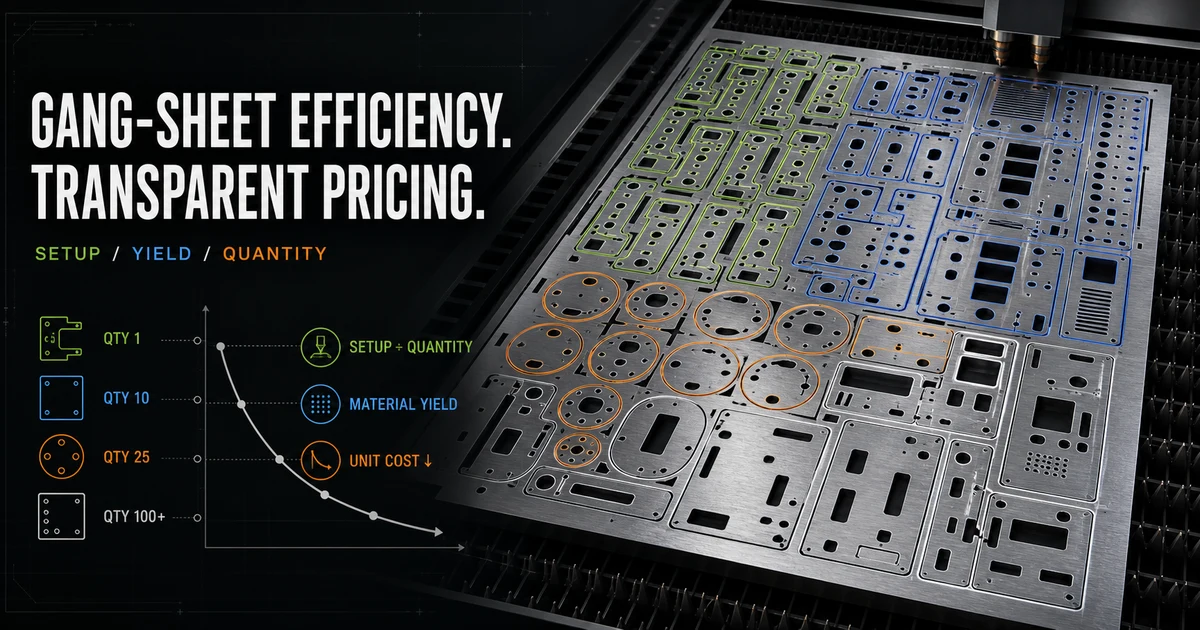
XeonNC2.webp)